The 08:14 to Leeds Does Not Need a Qubit: A Sceptic’s Guide to Quantum Rail Hype
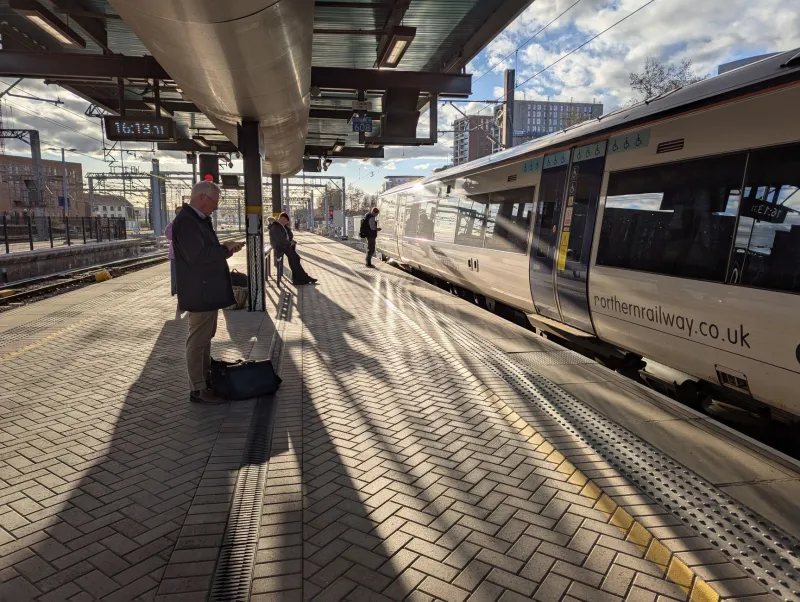
Every few months, a conference panel or a vendor slide deck announces that quantum computers will untangle Britain’s railways. The pitch is seductive: Britain has a crowded, ageing, gloriously complicated network; quantum computers are very good at complicated things; therefore, qubits will sort out the 08:14 to Leeds. It is a lovely story. It is also, for now, mostly a story.
The timetable is not one problem
Railway scheduling sounds like a single puzzle. It is more like a cupboard full of puzzles that keep breeding. There is timetable planning: deciding which trains run where, and when, months or years ahead. There is pathing: fitting trains through junctions and single-track sections without them trying to occupy the same bit of steel. There is platform allocation, crew rostering, rolling-stock diagrams, maintenance windows, passenger connections and disruption recovery. Each has its own constraints, its own data quality problems and its own humans who know where the spreadsheet lies.
Classical operations research has been chewing on this for decades. Mixed-integer programming, constraint programming, heuristics, simulated annealing and bespoke solvers are not glamorous, but they are battle-hardened. They also have a useful habit: they run on hardware you can buy, rent or shout at in a normal building. A railway timetable is a stubbornly classical problem until somebody demonstrates otherwise on a real railway instance.
Quantum optimisation, without the fairy dust
Most quantum-optimisation claims in transport come in two flavours. One is quantum annealing, where a problem is mapped onto a QUBO — a quadratic unconstrained binary optimisation problem — and a special-purpose machine hunts for low-energy configurations. The other is gate-based quantum computing, often using variational algorithms such as QAOA. Both are real research areas. Neither currently offers a proven, general-purpose advantage over the best classical methods for something as messy as a national timetable.
The awkward details matter. Today’s quantum processors have limited qubit counts, limited connectivity and noisy operations. Mapping a railway problem onto them can require extra qubits and clever embeddings, which eats into any theoretical gain. Many optimisation problems also involve precision and constraints that do not squeeze neatly into a quantum circuit. And a timetable is not a toy graph with twelve nodes and a nice picture in a paper. It is a sprawling, partly adversarial, human-influenced system with engineering rules that would make a combinatorialist reach for a biscuit.
That does not mean the research is worthless. It means the gap between a laboratory benchmark and a railway control room is wide enough to fit several trains, and possibly a replacement bus service.
‘Quantum-inspired’ is doing a lot of work
A lot of what gets marketed as quantum for railways is quantum-inspired classical software. That can be perfectly useful. Digital annealers, tensor networks, specialised heuristics and GPU-accelerated solvers may all earn their keep. But if it runs on ordinary silicon and produces ordinary bits, it is not a quantum computer. It is classical software with a press release that has been to a fancy dress party.
This is not just pedantry. Public money and management attention are finite. If a pilot project is really a classical optimisation trial, call it that. Then compare it with the classical baseline honestly. If a vendor claims a quantum advantage, ask for the instance, the baseline, the hardware, the error mitigation and the end-to-end time. A chart with no axis labels is not evidence; it is decoration.
Where the railway might actually use qubits
By the 2030s, the realistic contribution is likely to be narrow and hybrid. Think offline planning subroutines where a quantum processor handles a tightly scoped optimisation problem inside a larger classical workflow. Think research on disruption recovery for small subnetworks, or on rolling-stock allocation with carefully simplified constraints. Even then, the burden of proof is high: the quantum step must beat a strong classical solver, not a straw man, and it must do so reliably enough to justify the extra complexity.
Real-time delay recovery is an even harder sell. If a train is stuck outside Stevenage because of a signal failure, you do not need a dilution fridge. You need a signaller, a radio, a contingency plan and perhaps a flask. Quantum computers are unlikely to sit in a signal box replacing the people who already make fast, local decisions under pressure. The latency, infrastructure and integration costs are not small print; they are the main text.
There is also a category error in much of the hype. If you want quantum technology on the railway, quantum sensing may be the more plausible near-term story: gravity surveys, inertial navigation in tunnels, or precision timing. That is a different argument. Do not let a sensing success story be quietly repackaged as proof that your timetable solver is about to go quantum.
A sceptic’s checklist for the next rail quantum pilot
When the next announcement lands, ask a few boring questions. What is the actual problem size? Is the data from a real railway or a synthetic toy? What classical solver was used as the baseline, and was it well tuned? Does the claimed advantage survive end-to-end, including data preparation and embedding? What hardware was used, and would it fit in a railway planning cycle? Who is paying, and what happens when the pilot ends?
These questions are not anti-quantum. They are pro-reality. Quantum computing deserves serious research funding and serious scepticism in roughly equal measure. Britain’s railways deserve the same. The genuinely useful work will be done by people who can say ‘this is a classical problem for now’ without feeling that they have let the side down.
So no, the 08:14 to Leeds does not need a qubit. It needs a sensible timetable, decent infrastructure and a signaller who has had a cup of tea. If a quantum computer can shave a few per cent off a planning cycle in the 2030s, lovely. But mind the gap between a pilot project and a platform announcement. That gap is where the hype usually falls.