The Hole Truth: Why Britain's Roads Are Classical (and Our Excuses Are Quantum)
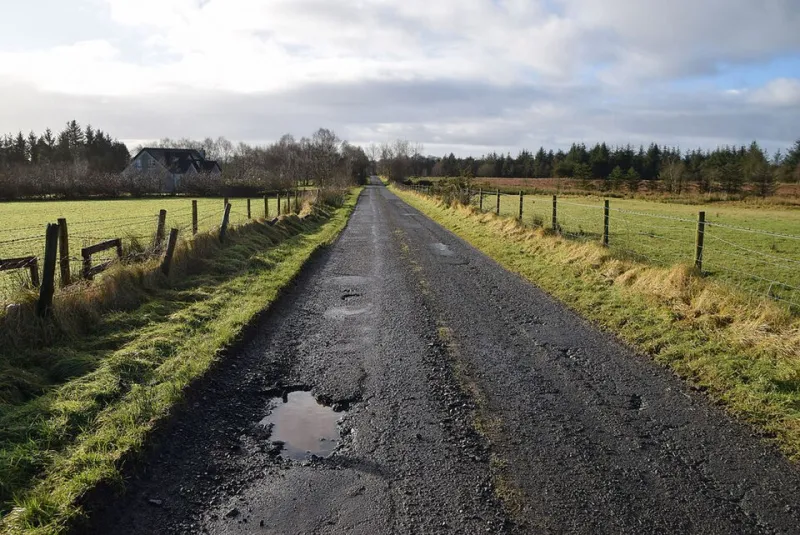
Photo: Kenneth Allen , CC BY-SA 2.0, via Wikimedia Commons
A pothole is not a wavefunction
There is a pothole on my street that has been there so long it feels less like a road defect and more like a local landmark. It has survived three councils, two winters and at least one attempt to rebrand it as 'surface texture'. Every time I cycle past, I perform a small act of quantum theatre: I pretend I have not seen it until the last possible moment, then swerve with the dignity of a startled badger. Is this Schrödinger's pothole? A crater and a smooth bit of tarmac until my front wheel observes it? No. It is just a hole. Britain's roads are many things, but they are not in superposition.
That has not stopped the metaphor from spreading. Potholes are a national obsession, and quantum mechanics is a national shorthand for 'weird thing we do not fully understand'. Put them together and you get a tempting joke: the road is both fine and ruined until you hit it. It is a good joke. It is also a useful reminder that humans are excellent at not noticing things until they become expensive.
What superposition actually says
In quantum mechanics, a system can be described by a superposition of possible outcomes. An electron can have a state that is a combination of spin-up and spin-down, for example. That does not mean it is secretly wearing two hats at once; it means the maths uses amplitudes for both possibilities, and a measurement gives one result with a probability. The moment the system interacts strongly with its environment, those delicate amplitudes leak away through decoherence, and the thing behaves classically. A pothole is interacting with air, light, grit, tyres and the occasional crisp packet. It decohered before the council filled it in. The 'observer effect' is not a licence for consciousness to shape asphalt. Looking at a pothole does not create it. Looking at it and doing nothing for six months is a different problem.
The only observer effect that matters
There is one genuinely observer-shaped quirk in the pothole world: the inspection. Councils use definitions and thresholds, and a hole may be 'not a pothole' until it meets a depth or size criterion. That is not quantum collapse; it is bureaucracy with a clipboard. The hole does not care. Your suspension does.
I spoke to Dr Priya Menon, a condensed-matter physicist who has spent enough time around quantum jargon to know when it is being used as a mood rather than a model. 'The road is not in a superposition. Your attention is,' she says. 'Quantum metaphors are fine if you label them as metaphors. The trouble starts when people use them to make a boring maintenance problem sound mysterious.' She adds: 'A pothole is a classical object. It is missing tarmac. No amount of looking will turn it into a wavefunction.'
Maya Fletcher, a cycling campaigner who has spent years lobbying for better surfaces, is even less misty-eyed. 'For a cyclist, a pothole is never in two states. It is either something you have seen or something that has just launched you into a hedge,' she says. Reporting systems can be fiddly, she adds, and a hole that looks minor in a car can be a wheel-bender on a bike. 'I do not need a wavefunction. I need a decent surface and a reporting app that does not ask me to upload a photo of my injured wheel.'
Where the metaphor helps, and where it papers over cracks
The quantum comparison is not useless. It is a decent way to talk about uncertainty, probability and the difference between what a model says and what a measurement gives you. It can also explain why 'it looked fine to me' is not a road-safety strategy. Human perception is selective. We drive the same route so often that the brain edits out the familiar. Then a wheel drops into a crater and the road suddenly collapses into a definite state: expensive.
The danger is when the metaphor becomes an excuse. If a pothole is in superposition, perhaps it is not really anyone's problem until it is measured. If the road is both fine and broken, maybe the budget can also be both adequate and imaginary. That is not quantum weirdness; that is just avoidance with better vocabulary. The pothole crisis is stubbornly classical: funding, maintenance backlogs, weather, heavy vehicles and the endless patch-and-pray cycle. Quantum talk is garnish. The main course is asphalt.
The collapse is human
The real 'collapse' happens in us. We ignore the road until it bites. We file the same defect under 'someone should fix that' and then under 'too late, I have hit it'. That is not physics. It is attention, habit and the UK genius for normalising a low-level national annoyance until it becomes a suspension bill.
So enjoy the joke. Call it Schrödinger's pothole if you must. But the only observer effect that will fix Britain's roads is the one where you observe a hole, report it, and then observe the council again until someone brings a lorry of asphalt. The pothole is classical. The excuses are the weird part.