The Compass With a Cold: Britain's Satellite-Free Navigation Trials and the Salt-Shaker Rule

Photo: NASA's Scientific Visualization Studio - Global Science and Technology, Inc./Amy Moran, Public domain, via Wikimedia Commons
Imagine the satnav dying halfway through the Blackwall Tunnel. Your phone says 'recalculating' with the confidence of a politician. Now imagine that happening to a warship, a container ship or a survey team mapping London's Victorian sewers. GPS is wonderful and fragile. It is jammable, spoofable and unavailable underground, underwater and in the wrong bit of the atmosphere. Hence the interest in navigation that does not need satellites — and hence the phrase 'GPS-free', which is currently doing a lot of heavy lifting in UK quantum labs.
What quantum sensing actually does
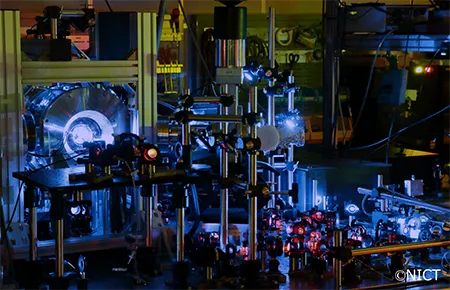
A quantum accelerometer uses atoms as test masses. Lasers cool them near absolute zero, then pulses of light split and recombine their wavefunctions. The interference pattern shifts when the apparatus accelerates. Measure the shift, infer acceleration. Integrate twice, get position — if you knew where you started and if your sensor were perfect. It is not. A quantum magnetometer uses atomic spins. Magnetic fields shift energy levels, and the apparatus measures how light is absorbed. That is useful for mapping and for sensing, not just for navigation.
The word 'quantum' here is doing real work. These are not classical accelerometers with a fancy badge. Cold atoms genuinely behave differently. But a quantum sensor is still an instrument. It has drift, noise, size, weight and power requirements. It does not abolish physics. It negotiates with it.
Why Britain cares
Satellite navigation is a strategic dependency. The Ministry of Defence knows it, the Royal Navy knows it, and anyone who has watched a ship's bridge go quiet during a jamming incident knows it. The UK has a long history in precision measurement and photonics, and the National Quantum Technologies Programme has pushed cold-atom sensing from lab benches towards real platforms. Royal Navy trials have put quantum navigation hardware on ships. UK labs have demonstrated shipboard and laboratory prototypes. Commercial shipping is interested because GNSS jamming in busy sea lanes has become routine. Underground mapping is interested because quantum gravimeters and magnetometers can, in principle, see buried pipes, cables and voids.
That is a serious research programme. It is also a magnet for hype.
What has actually been demonstrated
What Britain has shown so far is promising prototype hardware and trial data. What it has not shown is a pocket-sized, drop-in replacement for GPS. Quantum accelerometers are large, power-hungry, vibration-sensitive and expensive. They reduce drift; they do not delete it. Inertial navigation still needs a starting fix and periodic updates. 'GPS-free' often means 'GPS-denied for a while', not 'never needs a satellite again'.
This is not a criticism of the engineers. It is what early hardware looks like. The problem is the gap between a demonstration on a stabilised bench and a decade of North Sea crossings. A cargo ship is a noisy, vibrating, salty environment. A quantum sensor likes quiet. The hold is not a lab. Ruggedisation is a research programme in its own right.
The hype in the hold
When a press release says 'GPS-free navigation demonstrated', ask four questions. For how long? How far? In what sea state? With what starting fix? A one-hour trial on a calm day is a data point, not a replacement for a satellite constellation. A drift budget of metres after minutes is impressive in the lab and less impressive after a week at sea.
The salt-shaker rule is simple. Pinch one: size, weight and power. Pinch two: drift over time. Pinch three: environmental envelope. If any of these is left out of the headline, the headline is doing unpaid overtime. The Royal Navy and the Ministry of Defence should fund this work — it is genuinely strategic — but public funders and investors should reward honest milestones: hours of drift, not column inches.
North by quantum, with a caveat
The compass with a cold is a clever instrument. It is not yet a satnav replacement. It may become one for some platforms: a warship that needs a resilient backup, a survey vessel mapping the seabed, a tunnel-boring machine that cannot see the sky. That is a good market. It is not the same as a consumer gadget, and it is not the same as 'GPS is finished'.
Britain should keep building it. Britain should also keep the salt shaker in the hold. North by quantum is a lovely phrase. North by quantum with a fifty-metre drift after an hour is less lovely. The difference is engineering, and engineering deserves better than a slogan.