The Second Is Due an MOT: Britain's Atomic Clocks and the Case for a New Tick
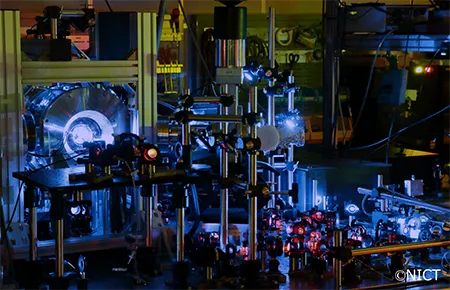
Photo: BIPM, CC BY-SA 3.0, via Wikimedia Commons
Every hour on the hour, the pips go out on the radio and a small, unexamined piece of national infrastructure does its job. Six beeps. Everybody resets their watch, or ignores it, and gets on with the day. Nobody asks where the second came from. The slightly unsettling answer is: a committee, a caesium atom, and a laboratory in a suburb of south-west London that most people couldn't place on a map.
That second is now being taken apart and rebuilt. Not because it's broken — it's the most accurate unit humanity has ever made — but because our clocks have outgrown the definition that governs them, and metrologists have reached the stage of any long relationship where they sit down and say: we need to talk about what we are.
The unit nobody argues about, until now
Since 1967, the second has been defined by caesium. One second is 9,192,631,770 oscillations of a particular transition in a caesium-133 atom. No microwaves, no pendulums, no astronomical guesswork — just a number of wiggles, agreed by treaty, reproducible in any decent lab.
It was a superb piece of work. It is also, by modern standards, a bit blunt. Caesium fountain clocks of the sort that still underpin official timekeeping are good to roughly one part in 10^16 — about a second in 300 million years, which sounds impressive until you meet the neighbours.
Those neighbours are optical clocks. By interrogating a transition that oscillates hundreds of thousands of times faster than the caesium microwave transition, optical lattice clocks at the National Physical Laboratory's Teddington site and its peers around the world have pushed uncertainty down towards the 10^-18 level. In human terms: a second lost every few tens of billions of years, which is longer than the universe has existed, which is a strange thing to write about a clock.
So the SI's headline unit is currently defined by an instrument roughly a thousand times less precise than the best instruments that exist. Metrology tolerates this with the grim patience of a person whose kitchen radio is stuck on a station they don't like. But only for so long.
Building a clock out of a lattice of light
The clock itself is not a machine with hands. It is a small vacuum chamber, a great deal of laser light, and a few thousand strontium atoms coaxed into sitting in a grid of standing waves like eggs in a carton — the lattice of the name. The atoms are cooled to within a hair of absolute zero, then a laser is swept across the frequency of the transition being measured. The atoms respond, the laser locks on, and the oscillation of that light becomes the tick.
Because optical frequencies are far too fast for any human-made counter, the output gets translated down via an optical frequency comb — a piece of laser physics that won a Nobel Prize and now sits in a rack, humming, earning its keep.
The clever bit is what the clock refuses to notice. Atoms in a lattice barely feel each other; the environment is controlled with obsessive care; the systematic errors that plague lesser clocks are measured, understood, and subtracted. What's left is a frequency that the universe seems to have set, and that nobody can change.
The paperwork is the hard part
Here's where the physics stops and the diplomacy starts. You cannot simply declare a new second because your clock is better. The consultative committee for time and frequency has set conditions that must be met before a redefinition is even proposed to the body that owns the SI. There must be several genuinely independent optical clocks, in different countries, demonstrably agreeing at the 10^-18 level. Their frequency ratios must be measured and cross-checked. There must be a credible answer to the administration question: how will everybody else get the new second? A standard nobody can disseminate is a laboratory curiosity.
The current target is a decision around the end of the decade, with the new second arriving some time after. As of 2026 the work is mid-flight: impressive hardware, growing confidence, and the usual sotto voce muttering about whether all the boxes will be ticked on schedule. Metrology is not a field that rushes, and it is not a field that makes a drama of not rushing.
What's actually at stake
This may sound like a hobby for people who enjoy spreadsheets. It isn't, quite.
Start with money. Trading venues are required to timestamp events to fractions of a millisecond, and the harder you chase the fastest orders, the harder the regulators squeeze the clocks. If your timestamps and mine disagree, the audit trail becomes a work of speculative fiction. Better timekeeping doesn't just make the numbers smaller; it decides who was first.
Then telecoms, where mobile networks need their base stations phase-aligned to within a tiny fraction of a second or the handovers go to pieces. Then the power grid, which uses time to work out where a fault happened and, increasingly, to keep inverters in step. Then satellite navigation, which is timekeeping wearing a hi-vis jacket — the position is a rounding error on a clock comparison.
And then Greenwich. Britain's long obsession with precision time is a hangover from an empire that needed to know where it was on the water, and the meridian at Greenwich is the bookmark that got left in the atlas. Longitude is time. The meridian is a time zone boundary dressed up as geography. When the second changes, that little line in a park changes with it — imperceptibly, admittedly, but the symbolism is doing work.
Accurate compared with what?
Here's the bit the pips never explain. A clock does not measure time the way a ruler measures a table. It measures its own oscillation and then you agree, socially, to call that time.
And relativity means the agreement is always local. Two clocks at different heights tick at different rates; a clock a centimetre higher experiences a slightly weaker gravitational field and runs a touch fast. Optical clocks are now good enough to see that centimetre. So the question 'what time is it?' has no single answer, only a convention plus a correction table.
Which is oddly comforting. The universe does not have a master clock with a warranty. It has processes, and fuzz, and a bunch of people in Teddington doing their level best to write a footnote to reality that everyone can agree on.
The second will change eventually. The new one will be a slightly different number of wiggles in a slightly different atom. Your microwave will still be wrong, the pips will still go out on the hour, and roughly forty people worldwide will be quietly thrilled. That's metrology: vast consequences, invisible to the customer.