Gravity's Ground Truth: The Quantum Sensor That Can See a Pipe Without X-Ray Eyes

A very British superpower: noticing the ground is slightly wrong
Gravity is not uniform. It is slightly stronger over dense rock, slightly weaker over a void, and faintly different over a buried pipe or a saturated patch of soil. Surveyors have exploited that for decades with gravimeters, but the instruments have often been heavy, slow or fussy. Quantum sensors promise something better: a gravity measurement tied to the fundamental properties of atoms, with less drift and the possibility of faster surveys.
In 2026, the interesting work is not a lab bench with a vacuum chamber and a hopeful postdoc. It is the muddy field trial: a sensor in a van, on a trolley or lowered down a borehole, trying to find a leak under a British pavement before the water company sends another apologetic letter. That is where atom interferometry stops being a physics demo and starts being a surveying tool.
How to weigh the Earth with falling atoms
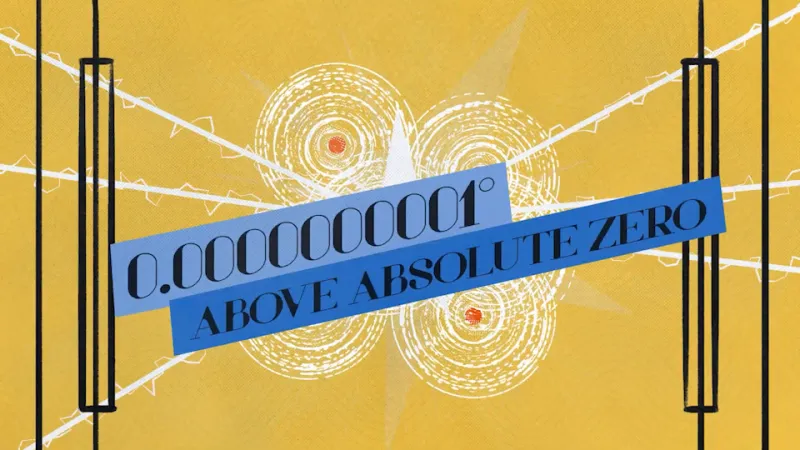
An atom interferometer uses atoms as test masses. First you cool a cloud of atoms — often rubidium or strontium — and launch or drop it. Then lasers split the atomic wavepacket into two paths, later recombine them, and read out the interference pattern. If the apparatus accelerates or if gravity changes along the path, the pattern shifts. From that shift you can infer acceleration or the gravity gradient.
A gravity gradiometer measures the difference in gravity between two nearby points. That is useful because a lot of noise — a passing lorry, a slamming door, a scientist dropping a clipboard — affects both points in the same way. Subtracting one from the other cancels the common-mode racket and leaves the tiny signal from a buried object. In principle, you can detect density contrasts underground without digging, drilling or deploying a small army of archaeologists with trowels.
The catch is that atoms are not magic. They need a vacuum, lasers, optics, vibration isolation and a power supply. The instrument must survive real-world temperature swings and transport. And the signal from a buried pipe is not a picture of a pipe. It is a subtle variation in the local gravity field, from which you have to infer a plausible underground model. Gravity sensing is not X-ray vision. It is a scale with a very good therapist.
From leaky mains to lost villas
The British use cases are wonderfully mundane. Water companies lose vast amounts of water through leaky mains, and finding the leak is often a matter of acoustic listening, guesswork and luck. A gravity survey can, in principle, spot the density change caused by saturated soil or a void around a broken pipe. Road engineers would like to find voids under carriageways before they become potholes with ambitions. Builders and planners would like to know what is under a brownfield site before the diggers arrive.
Then there is archaeology. Britain is a country where you cannot put in a conservatory without tripping over a Roman mosaic. Gravity surveys can reveal buried walls, ditches and cavities by their density contrast. A Roman villa under a field in Kent or a forgotten cellar under a car park is exactly the sort of target that makes a quantum sensor sound like a plot device from a Dan Brown novel. The difference is that a gravity survey produces data, not a chase scene.
But the mundane cases are also where the hype gets tested. A leaky pipe may be small, shallow and surrounded by noisy stuff. A pothole void may be tiny. An archaeological feature may be subtle. The question is not whether the physics works. The question is whether the instrument can find these things reliably, quickly and cheaply enough to beat the existing toolkit.
The trial-and-error bit
The UK has spent years building a quantum sensing ecosystem around atom interferometry, with university groups and national facilities working on smaller, more robust instruments. The 2026 story is less about a single miracle device and more about the unglamorous grind of field trials: reducing size, weight and power; automating alignment; making the software turn raw interference fringes into a map a surveyor can use.
That software matters. A quantum gravity sensor produces exquisitely sensitive measurements, but it does not tell you what is underground. You need inversion, modelling and ground truth. You need to compare the quantum result with a conventional microgravity survey, a ground-penetrating radar scan or an excavation. Without that comparison, you have a very precise number and a very vague story.
This is where scepticism is healthy. A press release that says a sensor could detect buried pipes is not the same as a sensor that has detected buried pipes in a blind trial. A lab demonstration with a vibration-isolated table is a seed, not a tree. A field trial that finds a known pipe is a useful step, but it is not the same as finding an unknown pipe in a noisy street. The difference between those two things is the difference between a magic trick and a tool.
How to spot a real advance
Ask four questions. Was the survey blind? Was the result compared with an independent method? Did the instrument work outside a controlled environment? And can the team repeat it on a different site with different soil, different weather and a different person driving the van?
If the answer is yes to all four, you have a genuine sensing advance. If the answer is a brochure with a picture of a Roman villa and the word revolutionary, you have marketing. The technology may still be excellent. It just has not yet earned the right to be called X-ray vision.
Ground truth, not magic
Quantum gravity sensing is one of the most plausible near-term applications of quantum tech. It uses quantum mechanics in a way that is robust, measurable and useful. It does not require a fault-tolerant computer or a million-qubit chip. It requires good atoms, good lasers and good engineering.
That is why the muddy field trial is more important than the shiny lab demo. Britain's buried pipes, potholes and Roman villas are not going to reveal themselves because of a press release. They will reveal themselves, if at all, because a sensor in a van measured a tiny change in gravity and a surveyor knew what to do with it. That is not magic. It is ground truth.