The Kettle Before the Qubit: Putting a Meter on Britain's Quantum Power Bill
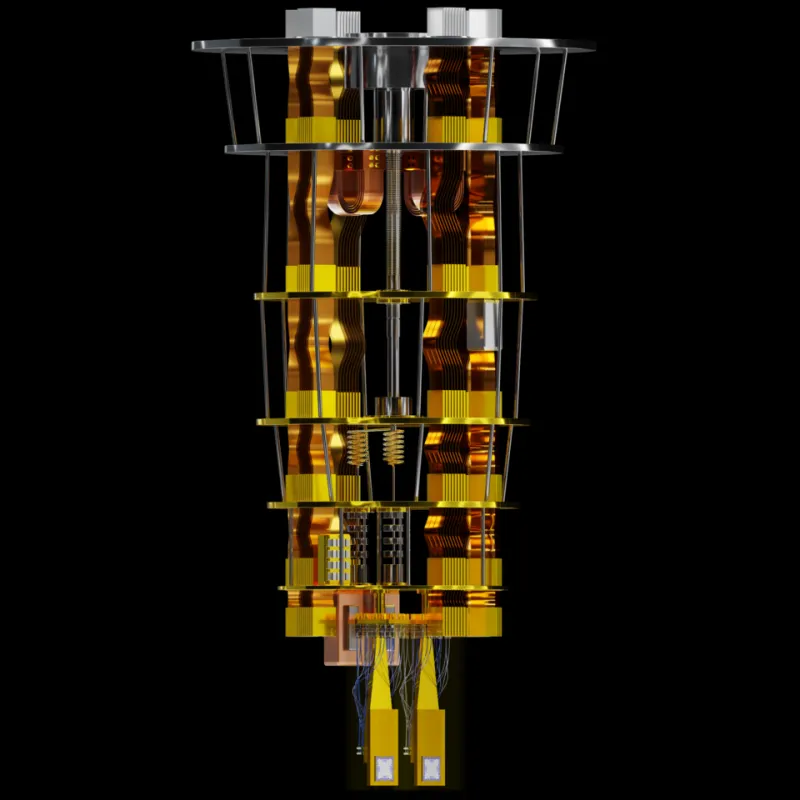
Photo: OJB Quantum, CC BY 4.0, via Wikimedia Commons
Quantum computing has a public relations problem that has nothing to do with error rates: it looks like a fridge. A very expensive, very cold fridge, humming away in a business park near you, drawing power whether or not anyone is solving a problem. The qubits get the headlines. The electricity bill gets filed quietly.
That is a strange omission. Britain has spent the past few years announcing quantum strategies, quantum missions, quantum clusters and quantum something-or-other in the Budget red book. The pitch is usually about sovereign capability, levelling up and, increasingly, net zero. Yet the humble kilowatt-hour rarely makes the slide deck. So let us do what the sector sometimes avoids: put a meter on it.
The fridge that never stops humming
A dilution refrigerator is the showpiece of any superconducting quantum lab. It gets colder than outer space, which is impressive, and it does so by compressing and expanding helium gas in a cycle that would make a Victorian engineer nod approvingly. The fridge itself is not the main drain. The supporting kit is: compressors, pulse tubes, vacuum pumps, control electronics, and the cryoplant that keeps the whole thing from warming up when someone opens the door to show a journalist the shiny bits.
A small dilution fridge might sip ten to twenty kilowatts. A larger system, with a bigger cryoplant and a cleanroom next door, can easily pull hundreds of kilowatts continuously. Unlike your kettle, it does not switch off after two minutes. It runs through weekends, bank holidays and the day the office boiler breaks. The qubits need the cold; the cold needs the power.
Doing the sums with a biro
Let us be clear about the epistemics here. Quantum labs do not publish itemised electricity bills, and I am not privy to their meter readings. What follows is a back-of-the-envelope reckoning, the sort of thing you do on the back of a electricity statement while waiting for the kettle. Treat the numbers as ballpark, not gospel.
Suppose a mid-sized UK quantum facility draws an average of 200 kilowatts across its fridges, cleanroom, servers and air handling. That is 200 kW times 8,760 hours a year, or about 1.75 million kilowatt-hours. Call it 1.75 gigawatt-hours. A typical UK household uses roughly 2,700 kWh a year for electricity, so the lab’s annual draw is in the region of 650 homes. If the facility is larger, with several fridges and a fabrication line, the multiplier climbs from hundreds into thousands of homes.
At a commercial electricity price somewhere around a quarter per kWh, that is a bill in the hundreds of thousands of pounds. For one lab. Before anyone has factored in the helium, the water, the replacement parts or the fact that someone left the cleanroom air handling on over Christmas.
What a household actually uses
It is worth grounding this. A terraced house in Leeds might use 2,700 kWh of electricity a year, plus gas for heating. A family with an electric car and a heat pump might use 7,000 to 10,000 kWh. A small supermarket might use 250,000 kWh. A quantum lab, in this rough reckoning, sits somewhere between a supermarket and a small housing estate.
That is not automatically scandalous. Universities run particle accelerators and supercomputers with similar appetites, and we do not demand they apologise for every electron. But the comparison matters because quantum computing is often described as a clean, green, future-facing industry. The green part is usually implied by the word “quantum” rather than demonstrated by a spreadsheet.
The clean room’s dirty secret
If the fridges are the headline, the cleanroom is the plot twist. Quantum chip fabrication needs air that is cleaner than a surgeon’s conscience, and keeping a cleanroom at that standard means moving a lot of filtered air, often 24 hours a day. HVAC systems in cleanrooms can dwarf the power draw of the fridge itself. Add ultrapure water, vacuum pumps and the general background hum of laboratory equipment, and the meter becomes a small industrial customer.
None of this is unique to quantum. It is true of semiconductor fabs, biotech labs and any facility that needs a controlled environment. The point is not that quantum is uniquely wasteful. The point is that the sector’s public story rarely includes the boring infrastructure that pays for itself in joules.
Net zero, net questions
So do the net-zero claims survive contact with a spreadsheet? The honest answer is: it depends what you count. If a lab buys renewable electricity, its scope 2 emissions can look tidy on paper. If it relies on gas-fired backup or grid electricity at peak times, the picture is muddier. And electricity is only one line item; embodied carbon in cryostats, helium supply chains and cleanroom construction all sit outside the meter.
A fair defence is that quantum computers might eventually do useful work that classical computers cannot, and that early-stage infrastructure always looks inefficient before it scales. That is a reasonable argument, but it is an argument about future benefits, not present net zero. The two should not be confused in a press release.
The bill arrives anyway
There is a version of this article that ends with a call to ban the dilution fridge and go back to abacuses. That would be silly. Quantum research is worth doing, and Britain is not alone in doing it. But if the sector wants public money and public trust, it should be willing to show the meter reading alongside the roadmap. A single line in the annual report — kilowatt-hours consumed, and what was done about them — would do more for credibility than another artist’s impression of a glowing qubit.
Until then, the next time you see a quantum computer described as tiny, cold and revolutionary, spare a thought for the kettle. It boils for two minutes and switches itself off. The fridge behind the qubit never does.