The Robin's Retina Is Not a Quantum Computer (Probably)
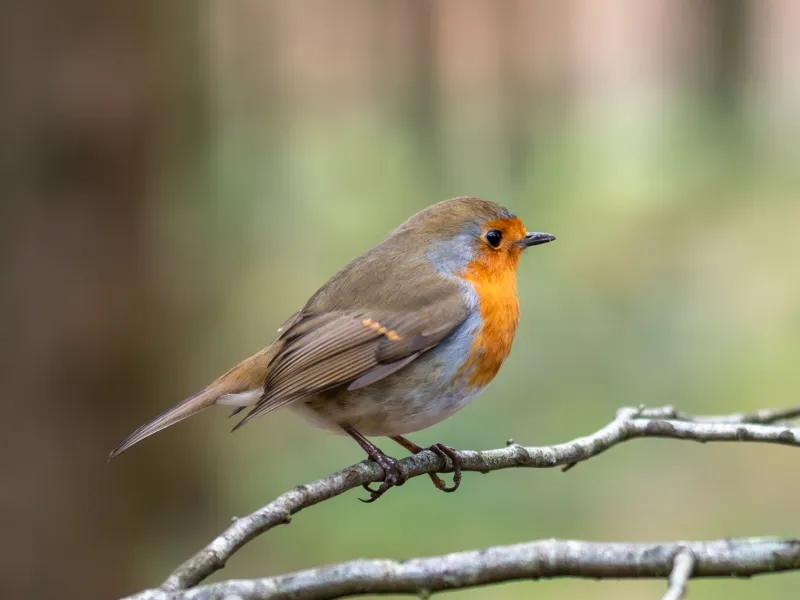
At about 7.15 on a grey November morning, a robin lands on the fence, puffs itself into a small orange football and fixes you with a look. You are holding tea. The robin, according to a certain flavour of science writing, is holding a quantum compass.
This is the claim worth examining: migratory birds may use quantum effects in their eyes to sense Earth's magnetic field. It is a genuinely interesting idea, backed by real experiments and real chemistry. It is also the sort of idea that attracts a thick crust of overstatement. So let us separate the robin from the jazz hands.
The claim, without the drumroll
The leading explanation is called the radical-pair mechanism. In birds, it centres on proteins called cryptochromes, found in the retina. When blue light hits a cryptochrome, it can trigger a transfer of an electron from one part of the molecule to another. That leaves two molecules each with an unpaired electron — a radical pair.
Unpaired electrons have a property called spin. The two spins can be correlated in a quantum way, and the magnetic field of the Earth can influence how they behave. That, in turn, can affect the chemical outcome of the reaction. The bird may, in effect, get a chemical signal that varies with direction. No tiny compass needle. No bird reading a map. Just a light-sensitive protein doing chemistry whose rules include quantum spin.
That is already strange enough. We do not need to dress it up as a bird with a PhD in quantum mechanics.
Why robins keep turning up in this story
European robins are classic laboratory subjects for magnetoreception research. In controlled experiments, robins placed in orientation cages have shown directional preferences under artificial magnetic fields. Researchers have also tested whether radio-frequency fields disrupt those preferences, and whether the colour of light matters. The results have been intriguing, but they are not a tidy proof.
Here is a necessary UK garden caveat. The robin on your fat balls is probably not a long-distance migrant. British garden robins are largely sedentary, and many are fiercely territorial. They share the basic sensory equipment with migratory relatives, but your particular bird is not necessarily navigating from Scandinavia to the Cotswolds. It may be doing the underlying biochemistry anyway. Or it may be doing something else entirely. The garden robin is a useful reminder that a familiar animal can be both ordinary and scientifically unsettled.
Cryptochromes for people who did not sign up for chemistry
A cryptochrome is a protein that responds to blue light. In the radical-pair story, the important moment is when light kicks an electron across a molecular gap. You can picture two electrons as a pair of indecisive shoppers in a small shop: their spins are linked, and the magnetic field is a slight tilt in the floor. The tilt changes how likely they are to end up in one arrangement rather than another. That changes the chemistry. The bird's nervous system may then read a difference between 'this way' and 'that way'.
What makes this quantum biology rather than ordinary biology is the spin correlation. What makes it plausible rather than magical is that the effect does not require a fridge, a laser or a laboratory vacuum. It may happen in a warm, wet, slightly grubby retina. That is the interesting bit. Warm, wet systems usually blur quantum effects quickly, which is why the radical-pair idea has been tested so carefully.
What would actually count as evidence?
A sceptic is not someone who says 'no'. A sceptic is someone who asks what would change their mind. For avian magnetoreception, useful evidence would include consistent behavioural responses to magnetic fields, a clear dependence on light wavelength, disruption by radio-frequency fields, and a plausible chemical pathway in the right part of the retina. Researchers have pursued all of these.
The trouble is that the picture is still patchy. Some behavioural effects are small and sensitive to lab conditions. Radio-frequency experiments have been disputed. Birds use multiple cues — the sun, stars, landmarks, smell, topography — and magnetism may be a backup rather than a satnav. Cryptochrome location and function in the bird retina are still being worked out. The radical-pair mechanism is a serious candidate, not a settled fact.
The UK angle: careful chemistry, not tabloid boffins
Britain has a real stake in this field. Groups at Oxford, including Peter Hore's lab, have done much to turn the radical-pair idea from a clever hand-wave into testable physical chemistry. That work is cautious, technical and often unglamorous: spectroscopy, spin dynamics, protein behaviour, and arguments about what can survive in a biological environment. It is the opposite of the headline that says scientists have discovered a quantum compass in a robin's eye.
There is also a broader UK research culture around quantum biology, animal navigation and sensory ecology. That is worth celebrating. It is less worth celebrating when a press release collapses the difference between 'may influence' and 'does control', or between 'a quantum effect is involved' and 'the bird is a quantum computer'.
The hype menu
Quantum biology attracts two kinds of overstatement. The first is the mystical version: nature is quantum, therefore everything is connected, therefore your bird feeder is part of the cosmic mind. The second is the gadget version: the robin has a quantum compass, so soon we will have quantum navigation in phones. Neither follows from the science.
A radical pair is not a quantum computer. It is a chemical reaction with spin-sensitive steps. The bird is not solving equations. It is receiving a signal from its own retina and doing whatever nervous systems do with signals. The honest question is not 'are robins quantum?' but 'which quantum effects, if any, matter to this behaviour, and how would we know?'
How to watch your robin without fooling yourself
You can enjoy the garden robin without turning it into a physics demonstration. Watch where it goes, what it eats, how it reacts to the window, the cat, the postman. Notice that it is a territorial animal with a busy morning. If you want to think about cryptochromes, think about blue light and chemistry rather than a tiny compass swinging in its skull.
And keep a little scepticism on the bird table. A robin appearing at 7am is not evidence of quantum navigation. It is evidence that robins are hungry, territorial and very good at finding food. The quantum question is separate, smaller and harder — which is exactly why it is worth asking properly.
So no, the robin on your fence is probably not doing quantum mechanics before breakfast in the sense of solving a Hamiltonian between bites. But its retina may be running a chemical calculation whose rules are quantum, and that is a stranger, more delicate idea than the hype allows. It is also very much a Quantum Soup kind of story: warm, messy and not yet fully strained.