Ten Millikelvin Above Oblivion: Chasing the Cold Inside Britain's Quantum Labs
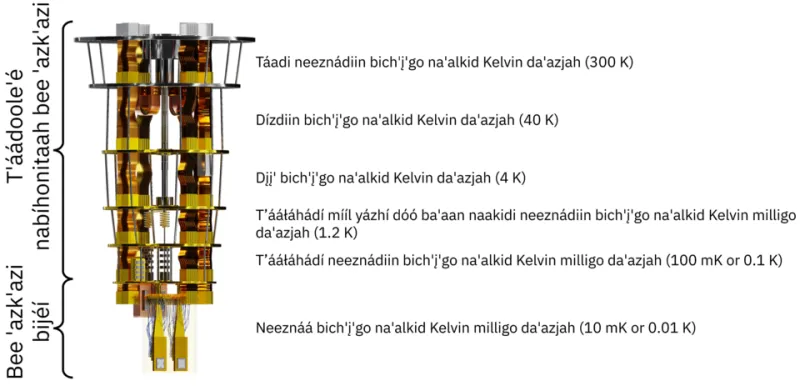
Photo: OJB Quantum, CC BY 4.0, via Wikimedia Commons
The machine sits in a room that hums. It is roughly two metres tall, plated in gold, threaded with a hundred gleaming coaxial cables, and it looks less like laboratory equipment than like the world’s most expensive espresso machine, designed by someone who has never met a coffee bean.
This is a dilution refrigerator. It is, by a wide margin, the coldest fridge in Britain, and its job is to keep a handful of superconducting qubits alive at around ten thousandths of a degree above absolute zero. For context: the cosmic microwave background, the afterglow of the Big Bang, glows at 2.7 kelvin. Deep space is about that cold too. This machine is more than two hundred times colder than the emptiest stretches of the universe.
And it is thirsty.
How to get colder than space in three crude steps
A dilution fridge does not work like the box in your kitchen. There is no compressor fluid doing lazy loops behind a grille, no ice tray, no ominous rattle at 3am. Instead, cooling happens in stages, and each stage has to drag heat out of the stage above it.
Step one: get to four kelvin. A pulse tube cryocooler, driven by a helium compressor chugging away in a corner, pulls the assembly down from room temperature to roughly 4 K — the boiling point of helium-4 at atmospheric pressure. That is already colder than anywhere on Earth naturally gets.
Step two: get to about one kelvin. Pump on a bath of liquid helium-4 to lower its vapour pressure and you shave off another few degrees. Now you are in the regime where superconductivity is ordinary and where the wiring starts to behave strangely.
Step three: the clever bit. Pump a mixture of helium-3 and helium-4 through the system and something lovely happens. Below about 0.87 K the two isotopes separate into phases, like oil and water. Helium-3, the lighter one, can be coaxed to cross from the concentrated phase into the dilute phase, and doing so absorbs heat — a continuous evaporative cooling effect with no moving parts in the cold zone. Cycle it round, condense it back, and you can sit at 10 millikelvin indefinitely. The cooling power down there is measured in microwatts. A single poorly shielded cable can dump more heat than the fridge can remove.
Why anyone bothers
The reason is noise. Superconducting qubits store information in quantum states whose energy gaps are tiny. Warm them a fraction of a degree and thermal fluctuations — the ordinary jostle of atoms — arrive like a crowd at a library and scramble everything. The rule of thumb is that thermal energy must be far smaller than the photon energy at the qubit’s operating frequency. Ten millikelvin is roughly the temperature at which that arithmetic starts to work.
It is also, incidentally, where some of the most delicate physics in the country happens: single-photon detectors, quantum-limited amplifiers, superconducting resonators, trapped-ion traps, and the growing zoo of devices that never see the light of day.
Britain’s cold spots
The National Quantum Computing Centre at Harwell, which formally opened in 2025, is the flagship — a building purpose-built around a growing fleet of dilution refrigerators and the engineers who babysit them. Oxford Instruments NanoScience, based just up the road in Abingdon, is one of the world’s leading manufacturers of these machines, which means a fair number of the fridges cooling qubits in California and Beijing were assembled in Oxfordshire.
Beyond that, the cold map is well spread: Bristol’s quantum engineering labs, Sussex’s ion trappers, Glasgow and Strathclyde’s photonics groups, and long-standing programmes at Cambridge, Oxford, Imperial and UCL. The National Physical Laboratory keeps its own fleet. Scotland has a cryogenics cluster; the Midlands is building one.
The thirsty bits
Three things keep a lab director awake at night, and none of them is physics.
The first is electricity. A large dilution refrigerator’s compressors draw somewhere in the region of ten to twenty kilowatts continuously, and they do not like being switched off. Add water chillers, lab air conditioning, magnet power supplies and the rest of a building full of instruments, and a serious quantum facility starts to look like a small industrial site on the meter. Qubits are cheap to run compared with the plant that keeps them cold.
The second is helium-3. It is not mined. Almost all of it comes from the decay of tritium in nuclear weapons stockpiles, and global production is measured in tens of kilograms a year. Prices have swung wildly over the past two decades. Labs now run closed-cycle recovery systems with the paranoia of a restaurant guarding its truffles, because losing a charge of helium-3 is not an inconvenience, it is a budget event.
The third, and the one that worries people most, is people. Cryogenic engineering is a small, specialised trade. The skill of diagnosing a blocked capillary at 4 K, or spotting the early signs of a quench before it costs you three weeks of cooldown, lives in the hands of a few hundred technicians worldwide. Britain has some of the best. It does not obviously have enough of them, and an apprenticeship in millikelvin plumbing is not yet a household career path.
The fridge has no off switch
Here is the detail that reframes everything. You do not turn a dilution refrigerator off. You cool it down over two to three days, run an experiment, and then, if you are sensible, keep it cold forever. Warming up and restarting risks thermal cycling, contamination, and days of lost beam time. A quench — a sudden loss of superconductivity somewhere in the magnet or wiring — can cost a month.
So the machine hums, day and night, through bank holidays, through the Christmas shutdown when someone has to come in and check it, through the heatwave when the chillers struggle. It is the least glamorous part of the quantum revolution and the part without which there is no revolution at all.
Which is worth remembering next time you read that Britain is on the brink of a quantum leap. Somewhere in Oxfordshire, right now, a very expensive fridge is quietly doing its job at a temperature that has no analogue on this planet, and its electricity bill is ticking over like a taxi meter in the rain.